
The Beginning of Symbolic Freemasonry: A Questioning of Its Origins and Historical Dating
Author: Master Mason, 33 degree; Brother Fabiano Bellati
Doric Lodge 140 – Fortlauderdale – FL – 2025
Abstract
The official foundation of modern Freemasonry is traditionally dated to 1717, when four London lodges united to form the first Grand Lodge. However, the symbolism contained in the foundational degrees of Craft Masonry suggests roots far older than medieval
stonemason guilds alone. This article investigates the hypothesis that symbolic elements, ritual tools, and initiatory structures found in Freemasonry already existed in much earlier civilizations—such as the Sumerians (4500 BCE), Egyptians (3200 BCE), as well as proto-
European societies like the Varna culture in present-day Bulgaria. A burial at the Varna Necropolis, dated to nearly 6,000 years ago, contains a ceremonial mallet strongly resembling the gavel used by Worshipful Masters. This study examines the presence of aprons, symbolic chambers, mallets, and ritual frameworks in ancient traditions and compares them to Masonic symbols. The findings suggest that the Freemasonry formally organized in 1717 may be a modern re-institutionalization of much older archetypal symbols, preserved, adapted, or rediscovered by various initiatory cultures throughout human history.
Keywords: Freemasonry, Varna Necropolis, ancient initiation, symbolic anthropology, ritual tools
Introduction
While 1717 is widely accepted as the administrative birth of modern Freemasonry, many scholars argue that this date does not represent the true beginning of the Masonic symbolic tradition. The philosophical foundations of Speculative Masonry—its degrees, symbols, and ritual structure—show striking parallels to ancient initiatory systems found in Mesopotamian, Egyptian, Hebrew, and Greek cultures.
These civilizations practiced initiation through secret teachings, hierarchical degrees, purification rites, and the use of ritual garments and tools—such as aprons and ceremonial mallets. Particularly relevant are archaeological discoveries such as those from the Varna Necropolis, where objects resembling Masonic symbols appear thousands of years before the rise of operative guilds.
Thus, this introduction establishes the central hypothesis: that Masonic symbols and
concepts may reflect ancient human archetypes, independently expressed across
civilizations long before the formal establishment of Grand Lodges.
Theoretical Defense
1. Scholars Who Proposed Ancient Origins for Freemasonry Researchers such as Manly P. Hall, Albert Churchward, Jean-Marie Ragon, Schwaller de Lubicz, and Gerald Massey explored the possibility that Masonic symbolism derives from ancient Near Eastern and Mediterranean mystery schools. Hall (1928) argues that Freemasonry did not invent its symbols but reorganized older wisdom traditions. Churchward (1913) identifies parallels between Egyptian initiations and Masonic instruments such as the gavel, apron, and columns.
2. Pyramids, Ritual Aprons, and Ceremonial Mallets in Egypt Egyptian sarcophagi depict ritual aprons and tools symbolizing moral transformation. Some
pre-dynastic burials include objects functioning as ceremonial mallets, representing spiritual authority—closely aligned with the Masonic gavel.
3. The Varna Connection: The Ancestral Mallet The Varna Necropolis (c. 4500–4200 BCE) reveals one of Europe’s earliest elite burials.
Among gold jewelry and ritual objects lies a mallet-shaped artifact suggesting authority, rank, or ceremonial leadership. This prehistoric mallet strongly implies that the symbolism of the gavel—order, judgment, leadership—is an ancestral archetype, not an invention of medieval guilds.
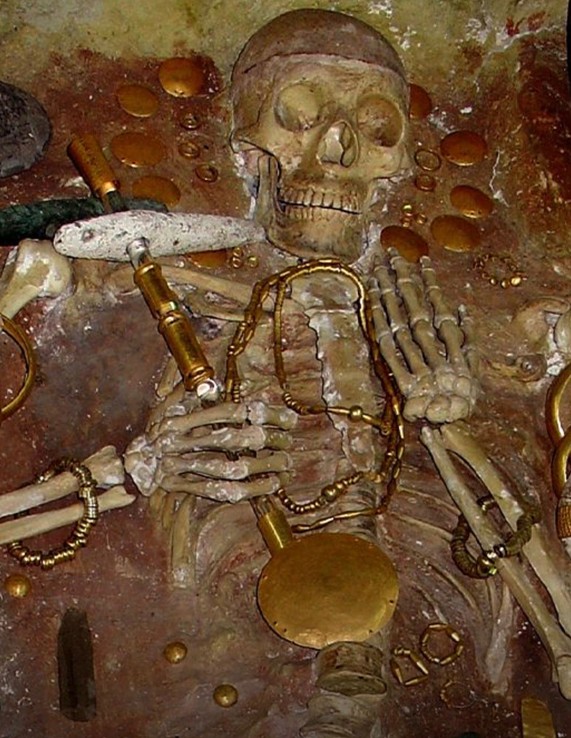
The Ancestral Mallet
4. Ritual Similarities Between Egypt and Later Traditions Ragon (1841) describes Egyptian initiatory rites involving tests, symbolic chambers, purification, and secret instruction—parallels to the Masonic Entered Apprentice degree. Schwaller de Lubicz (1949) interprets Egyptian temples as symbolic initiation spaces where sacred knowledge was restricted to worthy candidates.
5. Jesus and Possible Egyptian Philosophical Training Esoteric traditions and authors such as Gerald Massey (1907) suggest that Jesus spent formative years in Egyptian monastic schools, absorbing philosophical and symbolic teachings. While debated, this theory reinforces a long lineage of initiatory transmission
across cultures.
6. The Ark of the Covenant and Hebrew Initiatory Symbolism Built under strict specifications (Exodus 25:10–22), the Ark of the Covenant could be handled only by chosen initiates. Its symbolism—sacred geometry, secrecy, and ritual restriction—mirrors foundational Masonic principles. Special Chapter – The Varna Mallet and the Masonic Gavel Symbolic Connection Between the Varna Mallet and the Gavel Used by Masonic Worshipful Masters
The elite tomb at the Varna Necropolis—nearly 6,000 years old—contains one of the earliest assemblies of worked gold artifacts in human history. Among them lies a ceremonial mallet placed deliberately beside the deceased. In Freemasonry, the gavel represents legitimate authority, wisdom in leadership, moral regulation, and the ability to transform the rough stone into the perfect ashlar.
When one observes the Varna mallet, surrounded by gold signifying power and ritual status, it becomes impossible not to ask: Was this mallet a symbol of spiritual leadership? Did it represent judgment, order, or community guidance?
While Freemasonry does not claim prehistoric origins, the Varna artifact suggests that the symbolic essence of the gavel—authority, morality, initiation—predates written history.
Thus, the Varna mallet acts as an ancient mirror reflecting humanity’s long-standing search for ethical order and ritual leadership.
This naturally leads to the central philosophical question: Does Masonic history truly begin in the 18th century, or do its symbols emerge from a much older human legacy?
Conclusion
The evidence discussed strongly suggests that Freemasonry is not the creation of 18th-century England, but the culmination of symbolic patterns that permeate humanity’s oldest civilizations. The gavel, apron, ritual chamber, and progressive initiation all appear in various ancient cultures—from Egypt to Sumer to Varna.
While no direct institutional lineage can be proven, the symbolic lineage is unmistakable: the archetypes of initiation transcend time, geography, and culture.
Thus, the question remains open: Did Freemasonry truly begin in 1717, or did it merely resume a much older symbolic tradition?
References
Churchward, A. (1913). Signs and symbols of primordial man. Londres.
Hall, M. P. (1928). The secret teachings of all ages. Los Angeles, CA.
Massey, G. (1907). Ancient Egypt: The light of the world. London, UK.
Ragon, J.-M. (1841). Cours philosophique des initiations anciennes et modernes. Paris,
France.
Schwaller de Lubicz, R. A. (1949). The temple in man. New York, NY.
The Holy Bible, Exodus 25.